

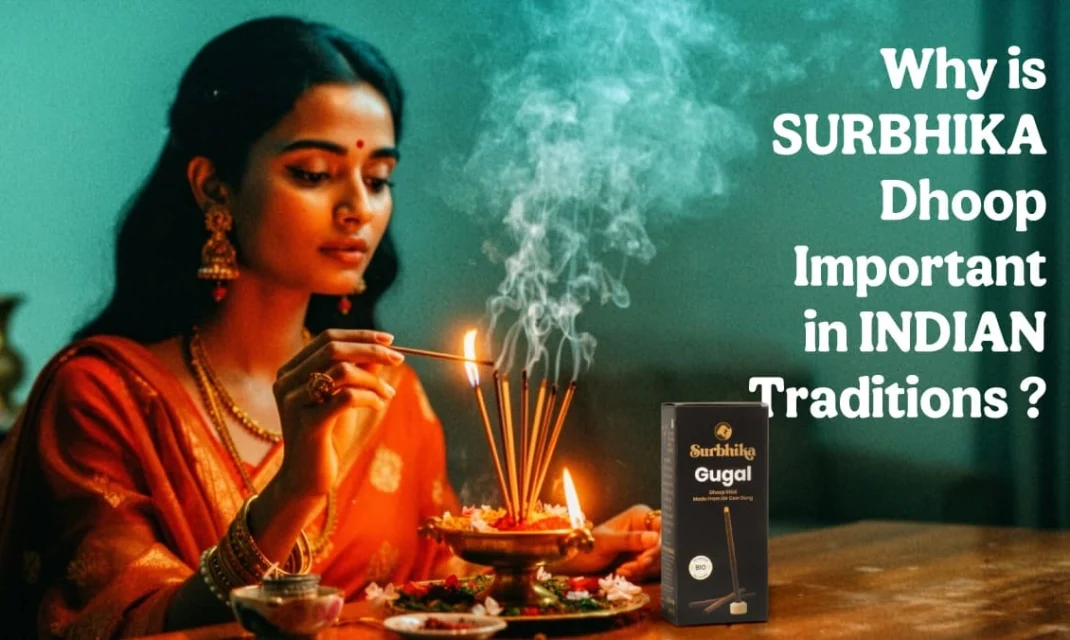
Is there a relation between in Dhoopam Kriya and use of herbal Dhoop in modern context ?
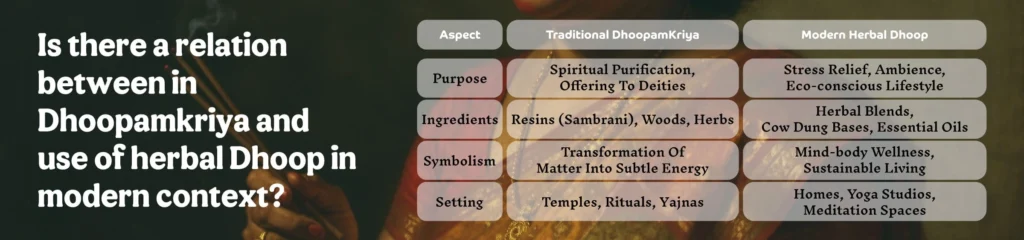
The relation between Dhoopam kriya and herbal dhoop today is one of continuity and adaptation. What was once a purely ritual act of sanctification has evolved into a holistic practice—serving spiritual, ecological, and therapeutic needs. Herbal dhoop allows modern households to honour tradition while embracing safety, sustainability, and emotional wellness.
Dhoopam kriya, the ancient ritual of offering fragrant smoke, finds renewed relevance today through the use of herbal dhoop, which bridges spiritual purification with modern wellness practices. In contemporary contexts, herbal dhoop is valued not only for its ritual symbolism but also for its eco-conscious, therapeutic, and family-friendly qualities.
| Aspect | Traditional DhoopamKriya | Modern Herbal Dhoop |
| Purpose | Spiritual purification, offering to deities | Stress relief, ambience, eco-conscious lifestyle |
| Ingredients | Resins (sambrani), woods, herbs | Herbal blends, cow dung bases, essential oils |
| Symbolism | Transformation of matter into subtle energy | Mind-body wellness, sustainable living |
| Setting | Temples, rituals, yajnas | Homes, yoga studios, meditation spaces |
Significance of Herbal Dhoop in Vedic rituals and sacrifices
In Vedic rituals and sacrifices, herbal dhoop holds profound significance as both a sacred offering and a purifier of the ritual space. Prepared from resins, woods, and medicinal herbs such as guggul, sambrani, and neem, the fragrant smoke is believed to carry prayers to the divine while simultaneously sanctifying the environment. The act of burning Surbhika herbal dhoop symbolizes the transformation of material essence into subtle energy, aligning the physical with the spiritual. Beyond its symbolic role, the Surbhika herbal blends were chosen for their therapeutic qualities—repelling insects, cleansing the air, and calming the mind—thus ensuring that yajnas and pujas were conducted in a pure, serene atmosphere. In this way, herbal dhoop served as a bridge between the cosmic purpose of sacrifice and the practical well-being of participants, embodying the Vedic vision of harmony between nature, spirit, and human life.
Is there a link between use of herbal Dhoop with Agni, prana and PanchTatva?
In Vedic rituals and sacrifices, herbal dhoop holds profound significance as both a sacred offering and a purifier of the ritual space. Prepared from resins, woods, and medicinal herbs such as guggul, sambrani, and neem, the fragrant smoke is believed to carry prayers to the divine while simultaneously sanctifying the environment. The act of burning Surbhika herbal dhoop symbolizes the transformation of material essence into subtle energy, aligning the physical with the spiritual. Beyond its symbolic role, the Surbhika herbal blends were chosen for their therapeutic qualities—repelling insects, cleansing the air, and calming the mind—thus ensuring that yajnas and pujas were conducted in a pure, serene atmosphere. In this way, herbal dhoop served as a bridge between the cosmic purpose of sacrifice and the practical well-being of participants, embodying the Vedic vision of harmony between nature, spirit, and human life.
Is there a link between use of herbal Dhoop with Agni, prana and PanchTatva?
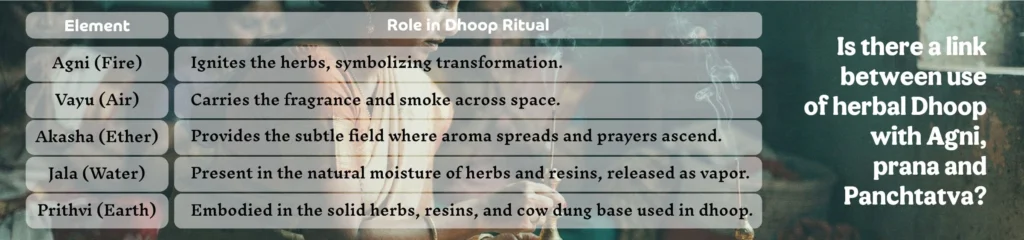
Lighting herbal dhoop is not merely about fragrance—it is a ritual of transformation. It invokes Agni as purifier, nourishes prana as life force, and unites the PanchTatva into harmony. In modern practice, this act bridges ancient symbolism with wellness, reminding us that every breath of herbal smoke is a dialogue between body, nature, and spirit.Its link with Agni, prana, and the panchtatva can be understood as follows:
Agni as the messenger: In Vedic tradition, Agni carries offerings to the divine. When herbal dhoop is lit, the smoke becomes an extension of Agni’s role—transforming solid herbs into subtle fragrance and energy.Agni also represents digestive and transformative fire within the body. The act of lighting dhoop mirrors this inner process of turning matter into energy, symbolizing purification and renewal.
Incense for pranic nourishment: The aromatic molecules released by herbal dhoop are inhaled, subtly influencing the breath and nervous system. This aligns with the idea that prana flows through the breath, and herbal smoke can calm, energize, or balance it.Just as prana animates the body, herbal dhoop is believed to vitalize the environment, making it conducive for meditation, yajna, or healing practices.
Lighting herbal dhoop engages all five elements simultaneously. Thus, herbal dhoop becomes a microcosmic yajna, harmonizing the five elements in a single act.
This is how it is:
Element | Role in Dhoop Ritual |
Agni (Fire) | Ignites the herbs, symbolizing transformation. |
Vayu (Air) | Carries the fragrance and smoke across space. |
Akasha (Ether) | Provides the subtle field where aroma spreads and prayers ascend. |
Jala (Water) | Present in the natural moisture of herbs and resins, released as vapor. |
Prithvi (Earth) | Embodied in the solid herbs, resins, and cow dung base used in dhoop. |
What is the correct herbal combination for a dhoop to become a harbinger of serenity, health and eco-consciousness?
A balanced herbal, charcoal-free dhoop like Surbhika typically combines sacred resins( cow dung), purifying herbs, and natural binders to create low-smoke, eco-conscious fragrance. A correct combination often includes Sambrani for its grounding aroma and antimicrobial qualities, guggul for spiritual sanctification and air purification, cow dung powder as a natural, smokeless base, neem leaves or powder for cleansing and insect-repelling properties, pure Bhimseni camphor crystals for ritual purity and respiratory clarity, and dry rose petals or sandalwood powder to soften the fragrance and add emotional warmth. Together, these ingredients harmonize the panchtatva—earth (herbs), fire (ignition), air (smoke), water (moisture released), and ether (fragrance diffused)—while ensuring safety, sustainability, and inclusivity for modern households.
How is the routine use of herbal dhoop related to seasonal and planetary alignment?
Seasonal and planetary alignment in dhoop practice reflects the Vedic principle that ritual fragrance is not arbitrary—it is cosmically tuned. Herbal smoke becomes a medium through which humans harmonize with nature’s cycles and planetary energies, ensuring that offerings are both spiritually potent and therapeutically relevant.In the Vedic worldview, the use of dhoop is not only ritualistic but also cosmically attuned, woven into the rhythms of seasons (ṛtu) and planetary alignments (Graha Shanti yoga).
ṚtuCharya & Dhoop
- Winter (Hemanta/Śiśira): Heavy, warming resins like guggul, sambrani, and camphor are used to balance kapha and protect against dampness, colds, and stagnation.
- Summer (Grīṣma): Cooling herbs such as sandalwood, vetiver, and rose petals are preferred to soothe pitta and calm overheated prana.
- Monsoon (Varṣā): Antimicrobial herbs like neem, turmeric, and frankincense are burned to purify air and prevent infections in humid conditions.
- Autumn/Spring (Śarad/Vasanta): Light, uplifting fragrances like tulsi, lavender, and citrus peels are used to balance vata and refresh the mind.
Thus, herbal dhoop becomes a seasonal medicine for both environment and psyche, harmonizing ritual with Ayurvedic rhythm.
Graha Shanti & Dhoop
Burning dhoop is seen as invoking Agni to carry offerings to planetary deities.
- Planet-specific herbs:
- Surya: Camphor and saffron—strengthening vitality and clarity.
- Chandra: Sandalwood, jasmine, and lotus—calming emotions and nurturing mind.
- Shani: Guggul—grounding, protective, and karmic cleansing.
- Mangala: Red sandalwood, cloves, and asafoetida—energizing, protective, and fiery.
- Guru: Turmeric, tulsi, and bay leaves—expansive, wisdom-enhancing, auspicious.
- Planet-specific herbs:
Why Choose Surbhika all herbal charcoal free Dhoop and incense ?
Surbhika’s all-herbal, charcoal-free dhoop and incense fulfil the criteria of Vedic authenticity, seasonal alignment, and eco-conscious wellness by using cow dung, natural herbs, and resins instead of synthetic binders or charcoal. These handcrafted blends are toxin-free, spiritually aligned, and designed for safe use in homes, meditation, and puja rituals.
- Surbhika products are explicitly marketed as charcoal-free and toxin-free, avoiding harmful smoke and indoor pollutants.
- Bases like cow dung powder and natural herbs replace synthetic binders, ensuring biodegradability and sustainability.
- Ingredients include sambrani, guggul, neem, camphor, sandalwood, and cow panchgavya (cow dung, ghee, milk derivatives), all of which are traditional Ayurvedic and Vedic substances.
- These herbs align with ritual purposes: purification, sanctification, and balancing prana.
- Designed for daily pooja, meditation, and yajna, Surbhikadhoop echoes the Vedic practice of Dhoopamkriya, where fragrant smoke is offered to deities.
- The smoke symbolizes transformation of matter into subtle energy, fulfilling the Agni principle.
- SurbhikaWinter blends (with sambrani, guggul, camphor) warm and purify.
- Surbhika Summer blends (rose, sandalwood, vetiver) cool and soothe.
- Surbhika Planetary herbs: camphor for Surya (Sun), sandalwood for Chandra (Moon), guggul for Shani (Saturn). Surbhika’s herbal range naturally supports graha-specific offerings.
- Marketed as aromatherapy incense, Surbhika emphasizes calm, focus, and emotional balance.
- Herbal smoke is believed to reduce stress, repel insects, and cleanse the environment, aligning with modern wellness needs.
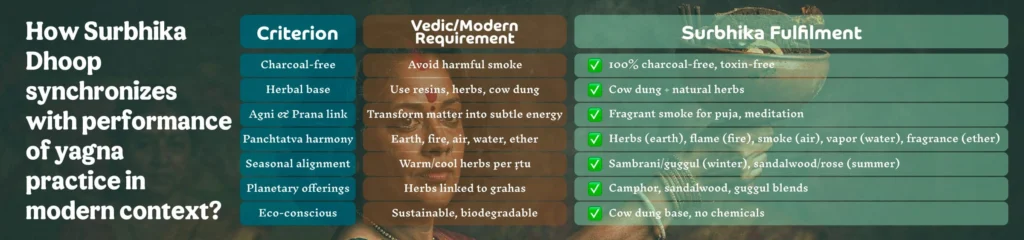
How Surbhika Dhoop synchronizes with performance of yagna practice in modern context?
Criterion | Vedic/Modern Requirement | Surbhika Fulfilment |
Charcoal-free | Avoid harmful smoke | ✅ 100% charcoal-free, toxin-free |
Herbal base | Use resins, herbs, cow dung | ✅ Cow dung + natural herbs |
Agni &Prana link | Transform matter into subtle energy | ✅ Fragrant smoke for puja, meditation |
PanchTatva harmony | Earth, fire, air, water, ether | ✅ Herbs (earth), flame (fire), smoke (air), vapor (water), fragrance (ether) |
Seasonal alignment | Warm/cool herbs per ṛtu | ✅Sambrani/guggul (winter), sandalwood/rose (summer) |
Planetary offerings | Herbs linked to grahas | ✅ Camphor, sandalwood, guggul blends |
Eco-conscious | Sustainable, biodegradable | ✅ Cow dung base, no chemicals |
 Gugal Dhoop Chhana Tikki ₹75.00
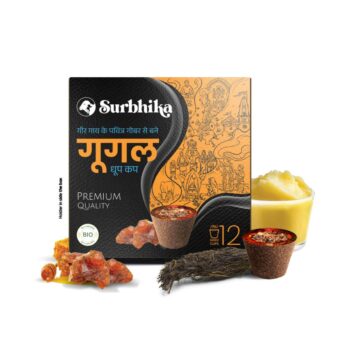 Guggal Sambrani Dhoop Cup ₹165.00
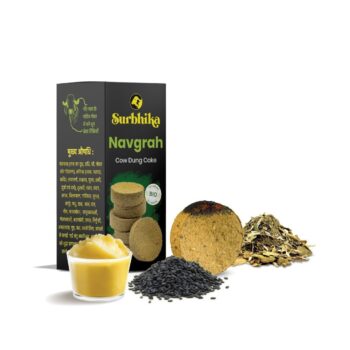 Navgrah Dhoop Chhana Tikki ₹75.00
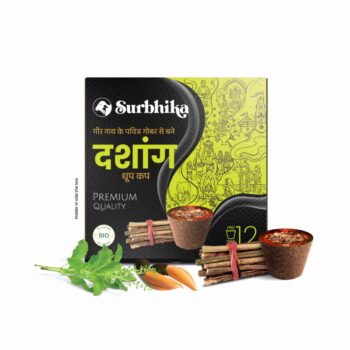 Dashang Sambrani Dhoop Cup ₹165.00
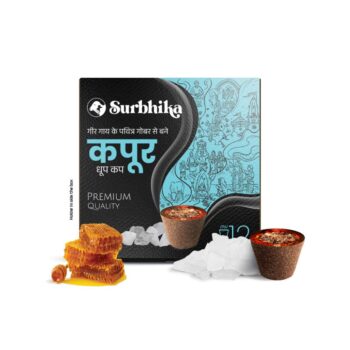 Kapur Sambrani Dhoop Cup ₹165.00
 Sacred Pyramid Triangle Dhoop ₹245.00
